Evaluating the KDP Interior Cocktail Recipe Journal for Print on Demand
The low-content and medium-content publishing sector on Amazon Kindle Direct Publishing (KDP) has matured significantly. Success in this space no longer comes from uploading generic lined notebooks; it requires niche specificity and functional design. For publishers targeting the mixology and beverage enthusiast market, a dedicated KDP Interior - Cocktail Recipe Journal represents a strategic asset. This specific digital resource provides a pre-formatted, 100-page interior designed explicitly for recording drink formulations, tasting notes, and ingredient ratios. Rather than spending dozens of hours designing layout grids or hiring a freelancer, creators can utilize these ready-to-use PDF files to accelerate their time-to-market while maintaining professional production standards.
This evaluation examines the practical utility, technical specifications, and commercial viability of integrating this cocktail journal interior into a Print on Demand (POD) portfolio. We analyze the file quality, user experience for the end customer, and the operational efficiency it offers to self-publishers managing multiple SKUs.
Technical Specifications and Production Standards
When sourcing interiors for KDP, technical compliance is non-negotiable. A rejection during the upload phase due to margin errors or bleed issues results in lost momentum. This KDP Interior - Cocktail Recipe Journal is engineered to meet current Amazon printing specifications out of the box. Understanding the included parameters helps prevent common publishing friction points.
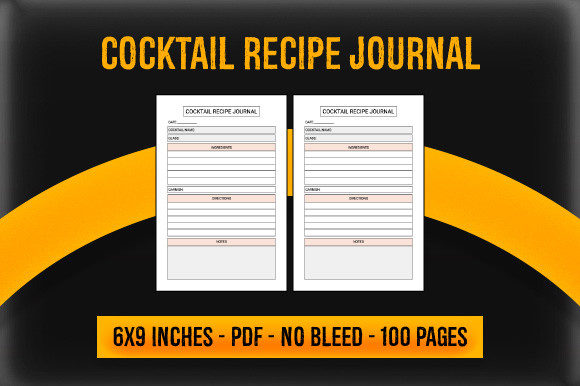
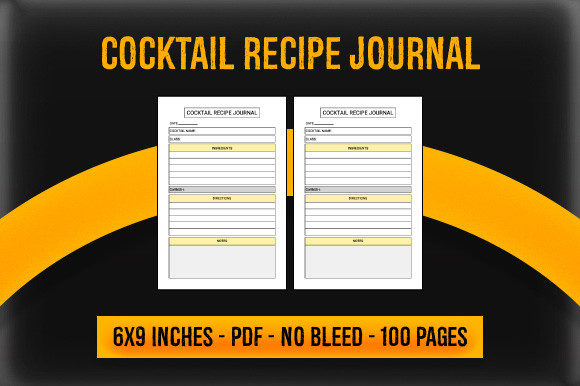
- Trim Size: The files are formatted at 6″ x 9″ inches. This is widely considered the industry standard for trade paperbacks in the hobbyist and reference category. It offers sufficient surface area for writing detailed recipes without being cumbersome to carry to a bar cart or kitchen counter.
- Page Count: The interior consists of exactly 100 pages. This count strikes a balance between perceived value and printing cost. At 100 pages, the spine is thick enough to accommodate text if desired, yet the base printing cost remains low enough to allow for competitive pricing and healthy royalty margins.
- Bleed Configuration: The package includes "No Bleed" formatting. This is a critical distinction for journals. By keeping all design elements, lines, and text boxes within the safe zone, publishers avoid the risk of content being trimmed off during the binding process. It also simplifies cover design alignment, as the interior does not extend to the physical edge of the paper.
- File Resolution: High-resolution PDF delivery ensures that lines remain crisp and text remains sharp after printing. Low-quality source files often result in pixelated borders or fuzzy text when printed via POD offset technology, leading to negative reviews. These files maintain vector-like clarity suitable for both black-and-white standard printing and premium options.
Functional Design and End-User Experience
A pretty layout does not guarantee sales; functionality drives repeat customers and positive feedback in the journaling niche. The primary value proposition of this KDP Interior - Cocktail Recipe Journal lies in its structured approach to data entry. Unlike a blank notebook, this interior guides the user through the essential components of mixology documentation.
Effective cocktail journals must account for variables unique to beverage creation. Standard lined paper fails here because it lacks designated spaces for garnish notes, glassware type, ice preparation, and flavor ratings. This interior addresses those gaps by providing consistent fields for:
- Recipe Metadata: Dedicated areas for the cocktail name, origin, date created, and occasion.
- Ingredient Breakdown: Structured lists for spirits, modifiers, sweeteners, and bitters with space for precise measurements (oz/ml/dashes).
- Preparation Method: Specific checkboxes or lines for shaking, stirring, muddling, building, or blending techniques.
- Sensory Evaluation: Rating scales for sweetness, acidity, bitterness, strength, and overall balance, allowing users to iterate on their creations over time.
- Visual Documentation: Space for sketching the presentation or noting color and clarity characteristics.
For the publisher, this level of detail transforms a simple notebook into a specialized tool. Customers searching for "cocktail log book" or "bartender recipe diary" are looking for this specific utility. Providing a product that genuinely solves the organizational problem of home bartenders increases the likelihood of organic conversion compared to generic alternatives.
Workflow Efficiency and Business Scalability
For entrepreneurs, freelancers, and small business owners operating in the POD space, time is the most constrained resource. Creating a high-quality, 100-page custom interior from scratch involves market research, wireframing, graphic design, typesetting, and proofreading. Even for experienced designers, this process can consume 10 to 20 hours per title.
Utilizing a pre-made KDP Interior - Cocktail Recipe Journal compresses this timeline dramatically. The workflow shifts from creation to curation and marketing. With the interior secured, the publisher can focus efforts on:
- Cover Design Differentiation: Since the interior is fixed, the cover becomes the primary variable for testing different aesthetics. Publishers can create multiple editions (e.g., vintage speakeasy style, modern minimalist, tiki theme) using the same reliable interior file.
- Keyword Research and SEO: Time saved on design is reinvested into finding long-tail keywords and optimizing backend metadata to improve discoverability.
- A+ Content Creation: With the interior finalized, publishers can immediately generate mockups and lifestyle images for Amazon A+ Content, which is crucial for converting browsers into buyers in the journal category.
- Portfolio Expansion: Rapid deployment allows for faster testing of adjacent niches. If the cocktail journal performs well, the same workflow can be applied to wine tasting logs, coffee brewing journals, or smoothie trackers.
This scalability is particularly valuable for educators teaching self-publishing, marketers building asset libraries, or serious hobbyists funding their passion through passive income streams. The reliability of a tested template reduces the variable risk associated with new product launches.
Strategic Considerations and Limitations
While ready-to-use PDF files offer significant advantages, they require a realistic assessment of limitations and best practices. Professional evaluation demands acknowledging where a product fits and where it may fall short.
Market Saturation and Differentiation
Because accessible interiors lower the barrier to entry, the cocktail journal niche sees regular influxes of new titles. Simply adding a cover and publishing is the baseline, not the strategy. To succeed, publishers must layer additional value. This might include creating a companion digital download, bundling the journal with relevant public domain cocktail guides, or targeting hyper-specific sub-niches (e.g., "Tiki Cocktail Journal" vs. general "Cocktail Journal"). The interior provides the foundation, but the brand wrapper determines success.
Customization Constraints
Ready-to-use PDFs are typically locked. You cannot easily add your logo to every page, change the font, or adjust the line spacing without rebuilding the file. For publishers who prioritize heavy branding within the interior, this lack of editability is a trade-off. However, for those prioritizing speed and clean, unbranded utility, this constraint actually ensures consistency and prevents accidental formatting errors during modification attempts.
Quality Assurance Protocol
Even with high-resolution source files, professionals should always order a physical proof before launching. Screen resolution differs from print output. Verify that the writing lines are dark enough to see but light enough to write over, and that the margins provide adequate thumb space for binding. While this KDP Interior - Cocktail Recipe Journal is designed to spec, individual printer calibration varies. Treating the digital file as a final draft rather than an absolute guarantee maintains professional integrity.
Audience Fit and Practical Application
Determining whether this asset aligns with your goals depends on your current position in the publishing lifecycle.
New Publishers: This interior serves as an excellent learning vehicle. It removes the technical intimidation of book formatting, allowing beginners to experience the full KDP pipeline—from upload to live listing—without getting stuck in design paralysis. The 6x9 no-bleed format is the safest starting point for understanding trim sizes and safe zones.
Established Publishers: For veterans with existing audiences in food, beverage, or hospitality niches, this interior functions as a catalog expander. It enables quick response to trending search terms or seasonal demand (e.g., holiday cocktail season) without diverting resources from flagship titles.
Educators and Coaches: This resource demonstrates the concept of "medium content" effectively. It illustrates how structure adds value beyond blank pages, making it a useful case study or recommended tool for students learning about niche selection and product-market fit.
Small Business Owners: Bars, restaurants, or catering companies can use this interior to create proprietary recipe books for staff training or as branded merchandise. The cost-effectiveness of POD means there is no inventory risk for small batch orders.
Final Assessment of Value
The KDP Interior - Cocktail Recipe Journal is a functional, technically sound component for Print on Demand businesses. Its value is derived not from uniqueness of the file itself, but from the efficiency and standardization it brings to the publishing workflow. The 6″ x 9″ dimensions, 100-page count, and no-bleed configuration align perfectly with current market expectations and Amazon’s production capabilities.
For professionals seeking to build a sustainable publishing operation, this interior should be viewed as infrastructure. It handles the structural heavy lifting, freeing creative energy for cover design, keyword optimization, and audience engagement. While it does not replace the need for market research or branding strategy, it reliably executes the production phase, allowing publishers to focus on the activities that actually drive revenue. In an ecosystem where speed and quality must coexist, having verified, ready-to-deploy assets is a practical advantage worth leveraging.