KDP Interior - Caregiver Log Book: Streamlining Production for Print on Demand Publishers
For self-publishers and Print on Demand (POD) entrepreneurs, the bottleneck in scaling a low-content book business is rarely the idea generation; it is the technical execution of high-quality interiors. The KDP Interior - Caregiver Log Book serves as a specialized production asset designed to bridge the gap between identifying a profitable niche and listing a compliant, professional product on Amazon. This resource is not merely a template but a foundational component of a streamlined publishing workflow, specifically tailored for the growing demand in senior care, home health assistance, and medical tracking documentation.
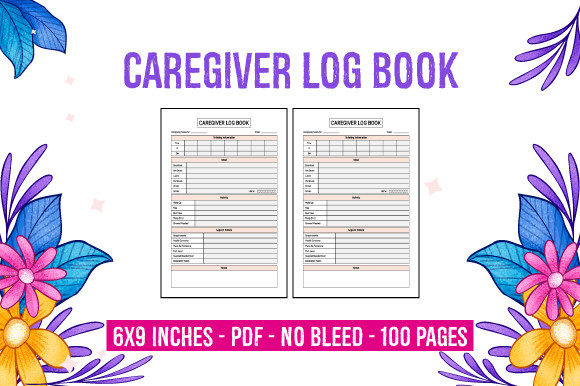
In the broader context of a POD business, this 100-page interior file functions as a pre-validated manufacturing base. Rather than spending dozens of hours designing grids, tables, and prompts from scratch, publishers can integrate this ready-to-use PDF directly into their assembly line. It addresses specific market needs—tracking medications, daily activities, vitals, and behavioral notes—while adhering to strict printing specifications. By utilizing a pre-formatted KDP Interior - Caregiver Log Book, creators shift their focus from repetitive layout design to strategic marketing, keyword research, and cover creation, which are often higher-leverage activities for sales conversion.
Technical Specifications and Platform Compatibility
Understanding the technical parameters of this digital asset is essential for preventing rejection during the KDP upload process. This specific interior is engineered with precise dimensions and formatting standards that align with Amazon’s current printing requirements.
- Trim Size: 6″ x 9″ Inches. This is the industry standard for portable log books, offering sufficient writing space while remaining easy to carry in a bag or store in a bedside drawer.
- Page Count: 100 Pages. This count provides substantial value to the end-user without significantly inflating printing costs, maintaining a competitive royalty margin.
- Bleed Configuration: No Bleed. All content is contained within safe margins, ensuring that no text or lines are trimmed off during the binding process. This eliminates common formatting errors associated with edge-to-edge designs.
- File Format: High-Resolution PDF. The files are optimized for print clarity, ensuring crisp lines and legible text at 300 DPI or equivalent quality standards required by commercial printers.
These specifications ensure compatibility not only with Amazon KDP but also with other POD platforms like IngramSpark or Lulu, should you choose to diversify your distribution channels later. The "No Bleed" setting is particularly advantageous for new publishers, as it reduces the risk of margin-related rejections and simplifies the cover creation process since the interior footprint remains static.
Integrating the Interior into Your Publishing Workflow
The true utility of a ready-to-use KDP Interior - Caregiver Log Book emerges when it is embedded into a systematic publishing routine. Treating this file as a modular component allows for faster iteration and testing of different cover styles and keywords against the same proven interior structure.
Pre-Publication Preparation
Before uploading, the interior file should undergo a brief quality assurance check within your existing workflow. Even though the file is ready-to-use, best practices dictate opening the PDF in a viewer to verify integrity. During this phase, consider how the interior interacts with your metadata strategy. Review the specific fields included in the log (e.g., blood pressure, glucose levels, mood tracking) to ensure your book description and backend keywords accurately reflect the content. Misalignment between what the customer expects based on your description and what they receive in the physical book leads to negative reviews. Use the interior's actual page layout to inform your "Look Inside" feature and A+ Content images, providing transparency that builds buyer trust.
Cover Design Alignment
Since the interior dimensions are fixed at 6x9 inches with no bleed, your cover design process becomes more predictable. You can set up your cover templates in Canva, Photoshop, or Affinity Publisher with exact spine width calculations based on the 100-page count. This interior acts as an anchor; once the interior is finalized, the cover becomes the primary variable for split testing. You might create one cover targeting professional home health aides and another targeting family caregivers, both utilizing the exact same KDP Interior - Caregiver Log Book. This approach maximizes the ROI of a single digital asset.
Post-Publication Analysis and Iteration
After publication, monitor customer feedback specifically regarding the usability of the log pages. If users mention that the font size is perfect for seniors or that the medication tracking section lacks necessary columns, this data informs future versions. Because you are using a standardized digital file, updating or creating a variation is significantly faster than redesigning from zero. The initial asset serves as a baseline for continuous improvement in your product catalog.
Practical Implementation and Quality Control
While the KDP Interior - Caregiver Log Book is designed for immediate use, successful implementation requires attention to detail. Publishers should adopt a checklist approach to ensure every unit produced meets professional standards.
- Verify Margins: Although designated as "No Bleed," always double-check the gutter margin. For a 100-page 6x9 book, ensuring adequate inner margin prevents text from disappearing into the binding crease, which is crucial for a functional log book where users write near the spine.
- Test Print Validation: Before launching broadly, order a physical proof copy. Digital screens cannot replicate the tactile experience of writing on paper. Verify that the paper weight supports pen or pencil without excessive bleed-through and that the line spacing accommodates average handwriting sizes.
- Metadata Synchronization: Ensure your seven backend keyword slots include terms derived directly from the interior's functionality, such as "daily health tracker," "senior care journal," or "home nurse documentation." The interior dictates the relevance of these terms.
- Category Selection: Place the book in categories that match the log’s specific utility. Beyond general "Medical" categories, look for niches in Aging, Gerontology, or Nursing where a structured log book solves a specific organizational problem.
Strategic Value for Low-Content Creators
For entrepreneurs managing multiple SKUs, efficiency is the primary metric of success. Creating a custom caregiver log from scratch involves researching medical tracking standards, designing consistent table structures, and formatting 100 individual pages. This process can take 10 to 20 hours per title. By leveraging a pre-made KDP Interior - Caregiver Log Book, that time investment drops to minutes.
This time saving allows for portfolio diversification. Instead of releasing one meticulously crafted book per month, a publisher can release several variations, testing different aesthetics and sub-niches within the caregiving vertical. Perhaps one version focuses on dementia care tracking while another emphasizes post-surgery recovery; both can utilize adapted versions of the same core interior architecture. This agility is critical in the POD space where trends shift and seasonal demands fluctuate.
Furthermore, using professionally formatted interiors mitigates the risk of amateurish design flaws that plague many low-content books. Consistent alignment, readable typography, and logical flow are built into the ready-to-use PDF. These subtle quality signals differentiate your product from competitors who use generic, poorly spaced templates. In the caregiving niche specifically, trust is paramount; users are documenting sensitive health information. A polished, well-structured interior communicates reliability and professionalism that encourages purchase and repeat usage.
Long-Term Asset Management
Treat this digital file as a permanent asset in your business library. Organize your files logically, tagging them by trim size, page count, and niche. When Amazon updates its printing specifications or margin requirements, having organized source files allows for quick batch updates. Additionally, consider how this interior might be repurposed. A caregiver log structure could potentially be adapted for pet care tracking, disability support documentation, or therapy session notes with minor modifications.
Ultimately, the KDP Interior - Caregiver Log Book represents a balance between speed and quality. It removes the technical friction of book formatting, allowing publishers to concentrate on understanding their audience and delivering value. Whether you are a seasoned KDP veteran looking to scale or a new entrant seeking a reliable starting point, integrating high-resolution, spec-compliant interiors into your workflow establishes a foundation for sustainable growth in the practical non-fiction market. The goal is not just to publish a book, but to provide a functional tool that genuinely assists caregivers in their demanding daily routines, and this interior provides the structural integrity necessary to achieve that outcome.